Sustainability Activities (ESG)
Promoting Diversity
Goals and Achievement Status
Promoting Diversity
Respect for Diversity: Approach and Policy
Mitsubishi Estate promotes human rights and diversity through the Mitsubishi Estate Group Guidelines for Conduct and positions respect for diversity as a guiding principle for employee conduct.
The basic mission of the Mitsubishi Estate Group is “to contribute to society through urban development.” We believe that diverse perspectives are essential to urban development that brings together a diverse range of people.
Our initiatives to embrace diversity, including members of the LGBTQ+ community, not only enhance employees’ psychological safety but are also closely connected to our approach to urban development.
Goals and Achievement Status
See the ESG data page for our progress in achieving diversity-related goals.

Empowerment of Women>Establishment of Action Plan to Promote Women's Success
Promotion of Women's Empowerment and Next-Generation Support
Establishment of Action Plans to Promote Women's Empowerment and Next-Generation Support
Mitsubishi Estate has formulated and publicly disclosed a General Employer Action Plan based on both the Act on Promotion of Women's Participation and Advancement in the Workplace and the Act on Advancement of Measures to Support Raising Next-Generation Children.
In line with these laws, the plan sets targets and initiatives to support women's career continuity and success, and to help employees balance work and childcare. Our goal is to create a workplace where everyone can work comfortably and productively.
The full text of the action plan is available here.

In addition, we have examined our future vision and set targets for the ratio of female managers: 20% by fiscal 2030, 30% by fiscal 2040, and 40% by fiscal 2050. In order to achieve these goals, we will promote gender balanced recruitment activities, introduce a personnel system that allows flexible work arrangements, hold internal roundtable discussions and seminars regarding balancing work and childcare for both men and women.

- Ratio of female managers at Mitsubishi Estate
*those in positions where they manage subordinates, or above, and those who are in equivalent positions even if they do not manage subordinates.
Hiring of Persons with Disabilities
Hiring of Persons with Disabilities
Mitsubishi Estate actively seeks to hire persons with disabilities, in response to social demands to ensure their employment opportunities. The company strives to create a workplace in which all employees can demonstrate their unique skills without regard to their disability and provide the environment they need for success.
LGBTQ+ Initiatives
Since 2023, Mitsubishi Estate has endorsed Business for Marriage Equality (BME) and has continuously implemented initiatives to deepen understanding of the LGBTQ+ community. Furthermore, in 2024, we revised our employment rules so that same-sex partners and their families are treated the same as in the case of opposite-sex marriage in principle, and we have informed employees about the details of the system.
See more detailed information about our LGBTQ+ initiatives
Message from the President
Mitsubishi Estate’s brand slogan is “A Love for People.”
Here are the sentiments behind that statement.
“People” is a word that encompasses all of our stakeholders, including our customers and Group employees.
It is also about all the members of our community, who live, work or visit the neighborhood.
How can we bring joy to each and every one of these people?
How can we make them happy?
How can we offer them dreams and inspiration?
We meet each day in constant pursuit of the answers to these questions.
Each and every Group employee engaged in urban development is passionate about fostering a working environment that empowers everyone to share their dreams and inspiration as they work.
“A Love for People” encapsulates this mindset and sentiment.
Under Mitsubishi Estate Group Long-Term Management Plan 2030, we have established “Respect for people” as one of the key themes set out in our strategies for increasing social value, and we aim to create urban areas and organizations in which a diverse range of people can thrive in order to help build “a society where diverse people can work and live happily.”
We believe that promoting diversity is not only a demand of external stakeholders (investors, shareholders, customers, job seekers, etc.) but also a driver of vitality in the workplace. We are committed to building a social and working environment that enables everyone, including members of the LGBTQ+ community, to work with confidence and actively participate while embracing diverse opinions.
At the Mitsubishi Estate Group, we are working to build an organization and a society in which each and every employee can take an interest in diversity, deepen their understanding, and express their authentic selves.
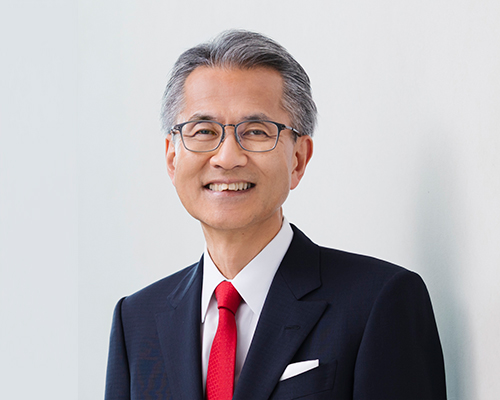
Atsushi Nakashima, Representative Corporate Executive Officer, President & Chief Executive Officer
Training Related to LGBTQ+ Issues
We hold training on unconscious bias for all employees, including officers, every year, providing the opportunity to think about fostering a culture that respects diversity. In addition, as part of the human rights component of our level-specific training programs, we raise awareness of the company policies related to promoting diversity and basic knowledge related to LGBTQ+ issues, such as the difference between coming out and outing and the appropriate responses, for example.
Fostering Internal Understanding and Culture
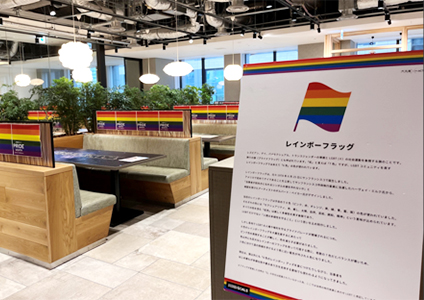
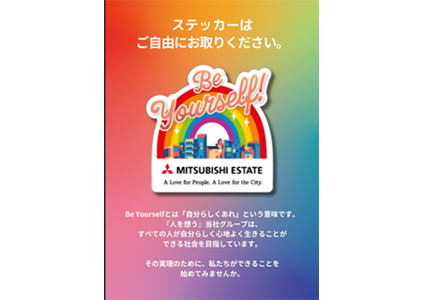
For Pride Month in June each year, we carry out LGBTQ+ awareness activities at employee cafeterias and the community space SPARKLE, where we disseminate a message from the President and publicize the initiatives of Group companies. We also display panels with basic information and distribute stickers to extend the network of allies. Furthermore, special rainbow-themed menu items are served at the cafeterias, for a fun way of showing our support.
We distribute Mitsubishi Estate Group LGBTQ+ stickers and online wallpapers to create an environment in which allies can engage in support activities more easily.
Providing Information
We have disseminated resources on diversity that includes our initiatives related to LGBTQ+ issues, such as the Human Rights Policy, the Code of Conduct, and training materials, all accessible at any time on a dedicated page on the internal portal site. We also support the downloading of online wallpapers that can be used as tools by allies. Besides this, we have prepared an LGBTQ+ guidebook with information provided on the portal site in order to ensure consolidation of basic knowledge about LGBTQ+ issues and facilitate the use of related systems.
Community Collaboration
With the community to which Mitsubishi Estate belongs (Otemachi, Marunouchi, and Yurakucho) as the starting point, we are implementing OMY SDGs ACT5 as a cross-corporate initiative aimed at promoting understanding of the LGBTQ+ community and of sexual orientation and gender identity (SOGI).
In February 2025, we launched the OMY Ally Network with several companies in the area and have been working to plan and operate Ally Networking Meetings to connect allies (with 149 participants from 51 companies) and to develop a community that transcends the boundaries of individual companies and foster mutual understanding. Going forward, we will continue with these activities.
In October each year, we hold E&J Fes, a diversity and inclusion event for companies, employees, and visitors in the area. Based on corporate and community collaboration, we promote widespread understanding of LGBTQ+ issues through movie screenings, panel exhibitions, and the participation of many people.
We promote initiatives in collaboration with various companies by organizing the E&J Lab, a study session and networking meeting for company staff with responsibility for personnel and diversity, equity, and inclusion (DEI) to share examples of corporate initiatives.
Establishment of Consultation Helpdesk
Mitsubishi Estate has established a specialized external consultation helpdesk that can receive consultations related to LGBTQ+ issues in addition to an employee consultation helpdesk staffed by employee advisors.
Various Programs for Work-Life Integration
Various Programs for Work-Life Integration
At Mitsubishi Estate, we believe in the importance of not creating barriers between work and daily life, but rather, in viewing both as one and achieving comprehensive fulfillment (work-life integration). To achieve this, we have established various systems that allow employees to choose a variety of work styles.
List of work-life balance and employee health promotion programs and welfare initiatives (Mitsubishi Estate)
List of work-life integration and employee health promotion programs and welfare initiatives (Mitsubishi Estate)
| Name of program | Overview of program |
|---|---|
| Flextime program | In principle, eligible employees can on prescribed working days work between 6.00 a.m. and 8.00 p.m. Note: The Company officially abolished core working hours (the period when employees are required to attend work) in April 2023. |
| Childcare leave of absence | Can be used until the end of the fiscal year in which the child turns three years old (14 days of paid leave from the day on which childcare leave starts) * The legally stipulated period in Japan is until the child's first birthday as a general rule (or until the child turns two years old as a maximum in special circumstances). |
| Nursing care leave of absence | Can be used for a maximum of three years (can be divided into shorter durations up to three times) |
| Nursing care leave of absence for children | Can be used until the end of the March after the child enters the third grade in elementary school Can be used as a special paid leave of absence until the child enters elementary school |
| Nursing care leave of absence for family | Can be used as a special paid leave of absence |
| Shortened work hours for childcare | Can be used until the end of the March after the child enters the third grade in elementary school Daily work hours can be shortened by up to 2.5 hours in increments of 15 minutes |
| Shortened work hours for nursing care | Can be used within three years of the start of use for each person in the eligible family Daily work hours can be shortened by up to 2.5 hours in increments of 15 minutes |
| Flextime program for pregnant women, those caring for children and those nursing family members | Can be used during pregnancy Can be used until the end of the March after the child enters the third grade in elementary school Can be used within three years of the start of use for each eligible person in the family (Work hours can be shortened by up to 2.5 hours in increments of 15 minutes) |
| "Refresh" vacations | Special paid vacations are given every five years after five consecutive years of employment Company pays travel costs after 25 or 30 years of consecutive employment (upper limit imposed) |
| Accumulated vacation | Employees can accumulate up to 90 days of paid vacation that was not used. This can be used for the employee's or family member's illness, a spouse's childbirth, to participate in volunteer activities, childcare or nursing care for family members, among others. |
| Retiree Reemployment System | Can be used following the specified interview when an employee resigned due to childcare, nursing care for family members, changing jobs, or starting a business |
| Leave system for the transfer of a spouse | Leave up to three years can be taken to accompany a spouse on a relatively short transfer (overseas traineeship/study of approximately 1-2 years) |
| Transfer request system for spouses relocating to a new location |
An employee in a position that does not normally involve transfers can transfer within the Group when wishing to relocate due to the transfer* of a spouse only when it is organizationally feasible
|
| Hourly paid leave program | Paid leave is available in one-hour units (using eight hours is equivalent to using one day of paid leave) |
| Teleworking program | It is possible to work at a location other than the company, such as a satellite office affiliated with the company or at home |
| Expense subsidy program based on cafeteria plan | The program provides subsidies for expenses on employee health promotion activities (sports activities and checkups not covered by insurance, etc.) |
| Consultations with occupational health physician | An initiative to provide consultations with an occupational health physician for employees, including managers, who have exceeded the 80 hours of statutory monthly overtime work |
| Positive Off Movement | An initiative to set targets for the number of days of paid leave taken and to encourage employees to take paid leave |
Scroll horizontally
Support for Combining Work with Raising Children
Support for Combining Work with Raising Children
Mitsubishi Estate has established a general action plan compliant with the Japanese law called "Act on Advancement of Measures to Support Raising Next-Generation Children," to help its employees balance work and childcare. The company is recognized as a childcare-supportive company by the Ministry of Health, Labour and Welfare and received Kurumin Mark certification in 2017.
As part of its efforts to support childcare, the Mitsubishi Estate Group provides support such as temporary daycare services using contracted daycare centers and subsidies for the cost of babysitting, as well as opening a center that helps employees find daycare services for their children. Information on programs available for childcare is provided on its intranet site for pregnancy, childbirth, and childcare information.
Support for Combining Work with Nursing Care for Family Members
Support for Combining Work with Nursing Care for Family Members
Mitsubishi Estate also offers a range of programs to support employees who are providing nursing care for their family. Employees can take nursing care leave or work shorter hours while nursing family members. In addition, a nursing guidebook is issued and internal seminars are held to offer information on caring for family members.
Support for Employees' Life Plans
Support for Employees' Life Plans
In fiscal 2024, Mitsubishi Estate extended the retirement age from 60 to 65 and established a new system that allows employees aged 60 and over to choose their retirement age.
We have also established an environment that allows experienced employees to play active roles, including provision of training on life and career planning before the age of 60. At the same time, the company has in place an early retirement system that provides additional benefits before the age of 60 and other programs, thereby meeting the diverse expectations of employees for life after retirement.

