Sustainability of the Mitsubishi Estate Group and Society: Four Key Theme
Related Initiatives (Respect for people)
Related Initiatives (Respect for people)
Related Initiatives
Flexible Living Solutions Supporting the Next Generation Ways of Work and Living
Recognizing the trends of declining birthrate, aging population, as well as evolving lifestyles and housing preferences, the Mitsubishi Estate Group has been promoting contributions to wellnessoriented living in an increasingly diversifying society by providing purpose-driven residential assets, including housing tailored to seniors and students with value-added services.
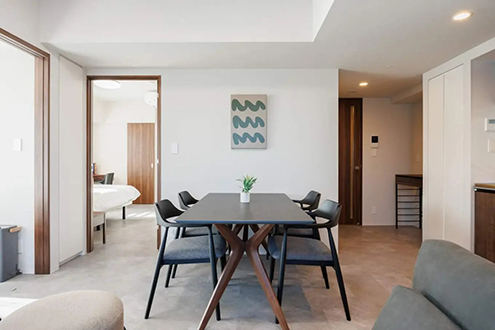
Since entering the flexible living business in 2019, the Group has responded to the growing number of international visitors and foreign residents in Japan, as well as the diverse lifestyle needs of globally mobile professionals, including digital nomads, expatriate employees, and international students by providing full furnished apartments. As of April 2026, a total of 1,866 units are in operation in Japan under the two brands of Hmlet and Blueground.
In April 2026, Mitsubishi Estate acquired 100% share of Habyt Pte. Ltd., which operates over 1,000 units in the flexible living sector in Singapore and Hong Kong, through the Company’s wholly owned subsidiary FL Japan Holdings Co., Ltd. The acquisition was made in anticipation of further growth in the sector among the next generation where flexible cross-border lifestyles continue to expand as it offers features not typically found in conventional rental housing or accommodation, including fully furnished units, flexible lease terms, and online contracting. Going forward, Mitsubishi Estate will expand its footprint in the Asia-Pacific region and strengthen its competitiveness by building a global platform. The Group will provide housing with community development features that encourage interaction between residents and establish residential infrastructure tailored to diverse ways of working and living, thereby achieving both sustainable business growth and creation of social value.


DIC Marunouchi — a Hub for Social Implementation of Inclusive Workstyles
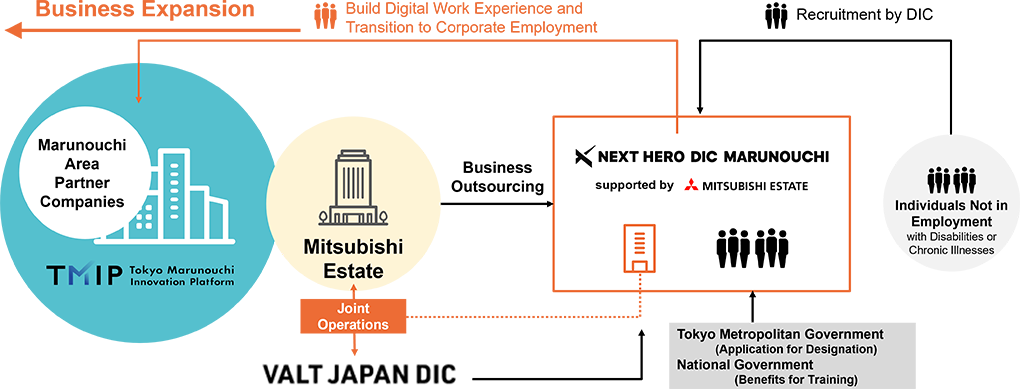
In February 2025, Mitsubishi Estate established Digital Innovation Center (DIC) Marunouchi,*1 the first Type A Continuous Employment Support Office for people with disabilities*2 specializing in a digital business in Tokyo’s 23 wards, in cooperation with VALT JAPAN Co., Ltd., a CVC investee, with the aim of creating an inclusive society where everyone can thrive.
DIC Marunouchi addresses two pressing social issues, the shortage of digital talent among companies and the low rate of employment of people with disabilities. By undertaking high-level digital tasks outsourced by the companies and offices concentrated in the Marunouchi area, it will create a new form of social infrastructure that secures employment opportunities for people with disabilities while delivering meaningful social impact.
In July 2025, DIC Marunouchi also began a collaboration with open innovation platform TMIP*3 to accelerate the creation of opportunities for people with disabilities to be involved in corporate activities through points of contact with a group over 400 member companies. More than 600 people have expressed interest in working at DIC Marunouchi and it has welcomed more than 50 companies for tours of its facilities.
Together with VALT JAPAN, Mitsubishi Estate will establish a new model for inclusive employment that balances social impact with economic value from its base in the Marunouchi district, one of Japan’s leading business centers. By expanding this model nationwide, the Group seeks to play a central role in realizing an inclusive society where everyone can thrive.
- Official name: Digital Innovation Center Marunouchi supported by Mitsubishi Estate
- Among the employment-related disability welfare services set out in the Act on Providing Comprehensive Support for the Daily Life and Life in Society of Persons with Disabilities, this refers to a service in which the business entity concludes a direct employment contract for provision of opportunities for employment and productive activities for persons with disabilities who have difficulty finding employment at conventional places of business but are capable of working under an employment contract.
- Official name: Tokyo Marunouchi Innovation Platform
Ongoing Human Rights Initiatives to Build a Responsible Supply Chain
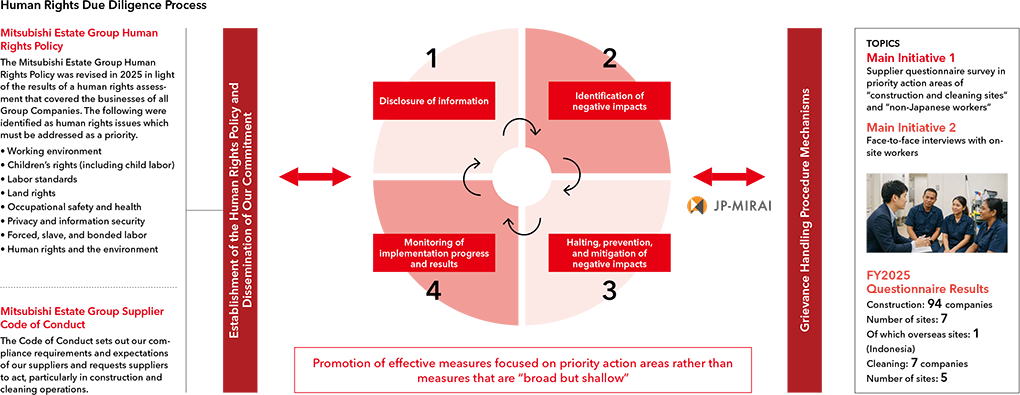
To ensure the sustainability of its global supply chain, the Mitsubishi Estate Group continues to implement human rights initiatives in line with the UN Guiding Principles on Business and Human Rights and the Japanese government’s Guidelines on Respecting Human Rights in Responsible Supply Chains. Under its Human Rights Policy, established in 2018, the Group clarified that its responsibility to respect human rights extends across its entire value chain. Following the introduction of the Mitsubishi Estate Group Supplier Code of Conduct in 2022, the process for identifying and assessing human rights risks has been systematized and managed using the PDCA cycles.
The Group has identified human rights of foreign workers, particularly those enrolled in skill development programs, as an area for priority action. In addition to conducting questionnaire-based assessments of contractors including second- and third-tier suppliers at construction and cleaning sites, Mitsubishi Estate carries out face-to-face interviews with on-site workers to ascertain site conditions, and through these efforts, the Group seeks to identify actual and potential adverse human rights impacts and to halt, prevent, or mitigate any negative impacts.
In terms of grievance handling procedures, we have introduced JP-MIRAI Assist, a consultation and grievance contact service that supports 23 languages, at construction and cleaning sites to protect the human rights of foreign workers.