Sustainability Activities (ESG)
Promoting Acquisition of Sustainability Certifications
Policy on Obtaining Environmental Certifications
Promoting Acquisition of Sustainability Certifications
- Policy on Obtaining Sustainability Certifications
- Environmental Design Policies and Incentive Programs
- Goals and Achievement Status
- Acquisition of SITES® Gold Certification for Tokiwabashi Tower and TOKYO TORCH Park, Thereby Becoming the First Urban Mixed-Use Development Project in Japan to Acquire Such Certification
- GRAND GREEN OSAKA Obtains Simultaneous “Gold” Ratings in LEED-ND Plan Certification and SITES Precertification for Mixed-Use Development Project Including an Urban Park
- Efforts to Acquire Environmental Certification in Overseas Business
Policy on Obtaining Sustainability Certifications
Mitsubishi Estate recognizes that addressing environmental and social considerations in real estate and indicating performance on these considerations externally is important to meet the expectations and demands of stakeholders such as tenants and investors. Therefore, the company has a policy of proactively obtaining sustainability certifications whenever possible.
In Japan, Mitsubishi Estate has obtained certifications that include DBJ Green Building Certification, Comprehensive Assessment System for Built Environment Efficiency (CASBEE), and Building-Housing Energy-efficiency Labeling System (BELS), while the main certifications obtained overseas include Leadership in Energy and Environmental Design (LEED) and BRE Environmental Assessment Method (BREEAM) certifications.
| Evaluation/Certification System | Overview |
|---|---|
| DBJ Green Building Certification |
DBJ Green Building Certification is a certification system established by the Development Bank of Japan (DBJ) in April 2011 as an initiative to support environmentally and socially conscious management of real estate. Based on a comprehensive assessment which covers such areas as environmental performance, disaster prevention, community considerations and other stakeholder engagement, the system evaluates and certifies real estate anticipated by society and the economy. |
| Comprehensive Assessment System for Built Environment Efficiency (CASBEE) |
CASBEE is a system for comprehensively assessing the quality of buildings, including interior comfort and consideration to landscape as well as environmental considerations such as energy conservation and use of materials and equipment with low environmental impact. It was developed by a research committee established for comprehensive environmental assessment of buildings in April 2001 as a collaborative project between industry, academia, and government under the auspices of the Ministry of Land, Infrastructure, Transport and Tourism, and has been continuously upgraded and maintained since. |
| Building-Housing Energy-efficiency Labeling System (BELS) |
BELS is a system for the assessment and certification of energy efficiency performance in newly built and existing buildings by a third-party organization. In April 2016, the scope of the system was expanded to residential buildings, and it was designated as one of the third-party certifications in the Guidelines on Building Energy Efficiency Labelling based on Article 7 of the Act on the Improvement of Energy Consumption Performance of Buildings (Building Energy Efficiency Act). Association for Housing Performance Evaluation and Labeling (Japanese only) |
| Leadership in Energy and Environmental Design (LEED) certification |
LEED is a system for assessing environmental performance of buildings and site use developed and operated by the U.S. Green Building Council (USGBC). |
| BRE Environmental Assessment Method (BREEAM) certification |
BREEAM is an environmental assessment system developed by Building Research Establishment Ltd. (BRE) in the U.K. in 1990 as a tool for assessing the sustainability performance of buildings, communities, and infrastructure. Performance is assessed in a total of ten categories including energy, health and well-being, water, materials, and waste, and rated on a five-point scale of Pass, Good, Very Good, Excellent, and Outstanding. |
| WELL Building Standard |
This is an environmental performance evaluation system for buildings and urban subdivisions with a focus on health and wellness. It is operated by International WELL Building Institute (IWBI) and certification is handled by Green Business Certification Inc. (GBCI). The latest version, WELL v2, was launched in 2020, and consists of the following 10 concepts: air, water, nourishment, light, movement, thermal comfort, sound, materials, mind, and community. |
| SITES Certification |
The Sustainable SITES Initiative (SITES). Designed by the U.S. Green Building Council (USGBC), which designs and updates the LEED rating system, the certification is administered by Green Business Certification Inc. (GBCI) in the U.S. It offers guidelines and a quantitative evaluation system on green infrastructure design, technology, and management. Certification is now available outside the U.S. with v2. |
| Energy Performance Certificates (EPCs) |
A system for assessing the energy efficiency of buildings on a seven-point scale from A to G. In accordance with the Minimum Energy Efficiency Standard (MEES) stipulated by law in 2015, office buildings that fail to achieve a B rating by 2030 can no longer be newly leased to tenants. |


Scroll horizontally
Environmental Design Policies and Incentive Programs
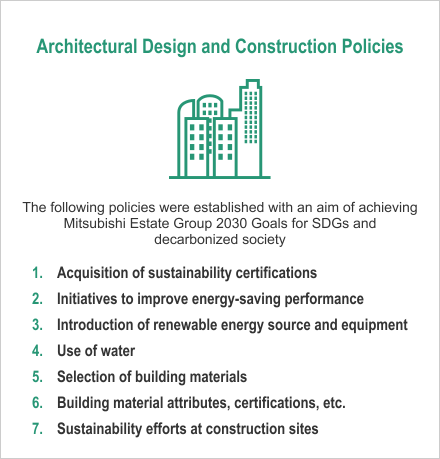
In working toward achieving the sustainability goals and KPIs—while enhancing the Group’s social value, one of the strategic goals put forth in its Long-Term Management Plan 2030—Mitsubishi Estate has established real estate development environmental design policies as well as incentive programs for projects with outstanding initiatives, to promote real estate development business that contributes to sustainability goals.
The Company has established the Sustainability-Minded Construction Architectural Design and Construction Policies for real estate development that outline the conditions required by type and scale, in areas such as design specifications, building materials, and construction methods.
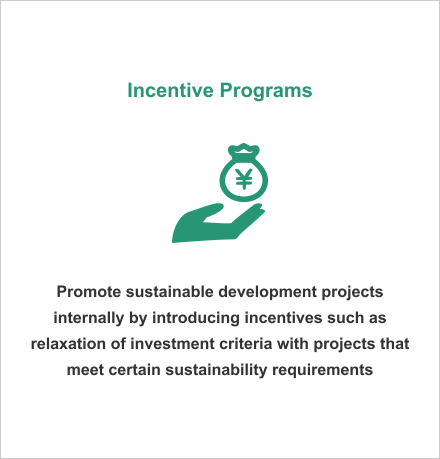
Additionally, in fiscal 2022, the Company launched programs that provide incentives to those implementing advanced sustainability initiatives in the process of deciding on investments in new development projects.
Goals and Achievement Status
Goals and Achievement Status
See the following for the status of environmental certification acquisitions.
ESG Data > E: Environmental data > (2) Other > 5. Green Building Certification
Acquisition of SITES® Gold Certification for Tokiwabashi Tower and TOKYO TORCH Park, Thereby Becoming the First Urban Mixed-Use Development Project in Japan to Acquire Such Certification
TOKYO TORCH Park
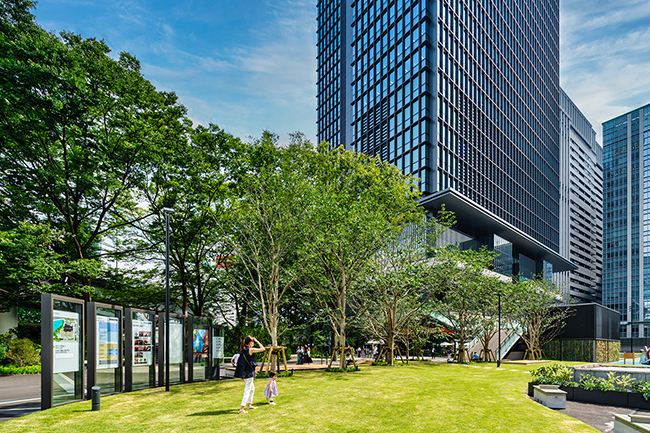
TOKYO TORCH Tokiwabashi Tower and TOKYO TORCH Park have acquired SITES® Gold Certification, an environmental certification that evaluates primarily the sustainability of landscapes, becoming the first urban mixed-use development project to receive such a certification in Japan.
Furthermore, these sites have been registered under Edo-Midori Green Area, a system by the Tokyo Metropolitan Government for registering and publicly announcing green spaces where native plant species are actively planted and where biodiversity is conserved. With this registration, TOKYO TORCH Tokiwabashi Tower and TOKYO TORCH Park have now acquired five environmental certifications—the others being DBJ (Development Bank of Japan) Green Building Certification, Social and Environmental Green Evaluation System (SEGES) certification, and Association for Business Innovation in Harmony with Nature and Community (ABINC) certification.
Going forward, we will continue to promote urban development with an even greater awareness of the environment, with the goal of opening all sites of the TOKYO TORCH project by fiscal 2027.
GRAND GREEN OSAKA Obtains Simultaneous “Gold” Ratings in LEED-ND Plan Certification and SITES Precertification for Mixed-Use Development Project Including an Urban Park
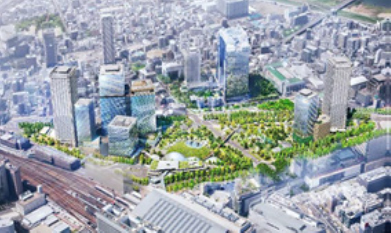
Panoramic view of GRAND GREEN OSAKA (rendering of completed project)
GRAND GREEN OSAKA, a mixed-use development led by Mitsubishi Estate Co., Ltd. in collaboration with eight partner companies (JV9), is based on the concept of creating “Osaka MIDORI LIFE” — a fusion of greenery and innovation. Centered around “Umekita Park,” which occupies 45,000 m² or approximately half of the district’s area, the project integrates diverse urban functions including offices, retail, hotels, and innovation facilities.The landscape design offers a sense of local flair, and environmental planning considers biodiversity. In addition, the project introduces cutting-edge technologies and infrastructure that contributes to resource recycling, such as use of renewable power in compliance with RE100, geothermal and wastewater heat energy and solar photoelectric generators. The mixed-use development project, which includes the urban park, is the first in Japan to simultaneously obtain gold certifications in the LEED Neighborhood Development (LEED ND) (plan certification) category for area developments by Leadership in Energy and Environmental Design (LEED), an internationally recognized green building rating system developed by the U.S. Green Building Council, and in The Sustainable SITES Initiative (SITES®) Precertification, which primarily evaluates landscape sustainability. The project has been awarded DBJ Green Building Certification, ABINC ADVANCE Certification, ZEB Oriented Certification (for office areas), and CASBEE Smart Wellness Office Certification through efforts to comprehensively evaluate and visualize the environmental value created by greenery.
Efforts to Acquire Environmental Certification in Overseas Business>Initiatives in the United States
Efforts to Acquire Environmental Certification in Overseas Business
Since Mitsubishi Estate New York was established in 1972, the Mitsubishi Estate Group has expanded its real estate development and leasing business in the U.S., the U.K. and other European countries, as well as Asia and Oceania, making the most of our track record and wide-ranging network. We are engaged in socially and environmentally conscious urban planning with people in these regions.
Initiatives in the United States
Based on a stable business foundation centered on the Rockefeller Group International Inc., the Mitsubishi Estate Group is engaged in a wide variety of real estate leasing and development businesses. In addition to operating our own building in New York, we are developing offices, residences, logistics facilities, etc. throughout the United States. We aim to raise the value of real estate with a focus on environmental performance, and therefore work to acquire LEED certification on both new development buildings and existing buildings.
Projects earning environmental certification (examples)
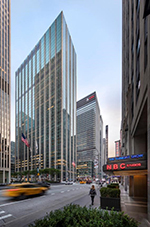
GOLD
1271 Avenue of the Americas, New York
Located in Manhattan, this building completed in 1959 underwent large-scale renovations from 2016 to 2019. The entire outer curtain wall was replaced and the air conditioning equipment was replaced with energy efficient models, resulting in the building attaining LEED Gold status in 2020.
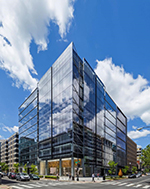
GOLD
1901 L Street, Washington, D.C.
Located in central Washington, D.C., this building was co-developed with the U.S. real estate company The Meridian Group. It is the result of an extension on a 1970s office building and large-scale renovations. The building was completed in 2019 following environmentally-friendly plans and was awarded a Gold LEED rating.
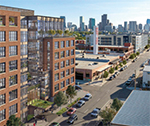
GOLD
Paradigm River North, Denver
Located in central Denver, this 8-story, 19,000 m2 office building was jointly developed with local real estate company Jordon Perlmutter & Co. Construction began in 2022 with a planned completion date of 2025. With environment-friendly plans, the project has earned a Gold LEED rating.
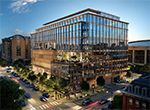
GOLD
600 5th/Washington D.C.
A joint development project with U.S. real estate company Stonebridge and Taisei Corporation in central Washington, D.C. The existing eight-story office building underwent a major renovation, including the addition of four floors, expanding it to 11 stories plus a penthouse. Construction began in 2023 and was completed in 2026. The project received LEED Gold certification in 2026 in recognition of its environmentally conscious design, including the creation of green spaces and reduction of embodied carbon.
Initiatives in Europe
Initiatives in Europe
Since the establishment of Mitsubishi Estate London in 1986, the Mitsubishi Estate Group has handled real estate leasing and development projects for office, rental housing, and logistics properties in central London and continental Europe. With an emphasis on the environmental aspects of its properties the Group has earned BREEAM, LEED, and WELL certifications for newly developed buildings as well as buildings already owned.
Projects earning environmental certification (examples) 


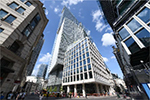
BREEAM Outstanding (planned)
8 Bishopsgate, London
8 Bishopsgate, a large-scale office redevelopment project in the City of London completed on June 19, 2023, has achieved the highest ratings in multiple environmental certifications.
In the U.K., the RIBA 2030 Climate Challenge, a set of targets developed by the Royal Institute of British Architects (RIBA) for energy and carbon use in the construction industry based on the UN Sustainable Development Goals (SDGs), has been established and the property complies with these targets. In addition to using a glass façade with outstanding environmental performance for the entire exterior, the property is also equipped with solar panels and reuses greywater from rainwater, as well as other environmentally-friendly measures. As a result, it has earned the highest rating of Outstanding in BREEAM certification. It has also been certified with the highest “A” EPC Rating, which indicates the energy efficiency of a building in operation. In order to enhance diverse workstyles and well-being, an exclusive tenant-use cafeteria and an adjacent outdoor terrace are located on the mid-rise floor, with a large town hall and a business lounge on the low-rise floors. As a unique feature in the U.K., where environmental awareness is growing, there are no car parks, with the building instead featuring a large bicycle park and shower facilities. Beyond being environmentally friendly, the building also supports a working life for workers.
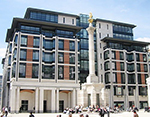
BREEAM Excellent
Warwick Court, London
Warwick Court is a major office refurbishment project that was completed in July 2022. By maximizing the use of the existing façade and structure, and also reusing the interior stones from the building reception, this structure achieved a substantial CO2 emissions reduction of approximately 70% compared to new construction. Moreover, the building contributes to the well-being of workers by installing a new rooftop terrace and a tenant-exclusive terrace, as well as by providing shower and other facilities. Through these efforts, the building has earned the BREEAM Excellent rating.
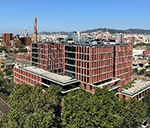
LEED Platinum/WELL Platinum
Cristóbal de Moura, Barcelona
Cristóbal de Moura is an office development project in Barcelona, Spain that was completed in January 2023. By installing solar panels and LED lighting, the development has achieved a reduction of approximately 23% in energy consumption compared to ordinary office buildings in the same region. Other measures taken include the reuse of rainwater. The development has also established facilities that contribute to promoting diverse work styles and well-being for workers such as outdoor terraces established on multiple mid-rise floors and a co-working lounge, gym, showers, and bicycle parking on the low-rise floors.
Through these efforts, the project has earned the highest-level Platinum rating in both LEED and WELL certifications.
Initiatives in Asia and Oceania
Initiatives in Asia and Oceania
Since establishing Mitsubishi Estate Asia Pte. Ltd. in Singapore in 2008, we are promoting real estate business in countries in Southeast Asia and Oceania, such as Vietnam and Thailand. In 2021, Mitsubishi Estate Asia opened its Australian branch in Sydney. We are also promoting development of office buildings, residences and commercial complexes through local subsidiaries in East Asia such as China and Taiwan.
Projects earning environmental certification (examples)


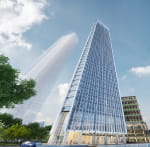
Trinity Tower, Indonesia
This is a large-scale office building project which Mitsubishi Estate has developed jointly with The Gesit Companies, Santini Group, and Shimizu Corporation. The project was awarded Best Green Development in the PropertyGuru Indonesia Property Awards 2018, which is given to outstanding real estate projects in Indonesia, in recognition of its advanced environmentally-friendly initiatives. With the commencement of building operation in July 2021, the project earned a Gold rating by the Green Building Council Indonesia (GBCI) in its Greenship New Building (NB) Version 1.2 rating platform.
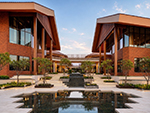
Sira Village Grand Outlet Bali, Indonesia
Mitsubishi Estate’s participation in this project was announced in December 2023. The project is the first luxury outlet shopping mall in Bali, Indonesia and is being develped in partnership with PT Bali Turtle Island Development (BTID), which is developing a mixed-use resort on the site.. Sira Village Grand Outlet Bali opened in the summer of 2026. We plan for the project to earn the Building and Construction Authority (BCA) Green Mark Certification (Gold) for its environmentally-friendly plans.
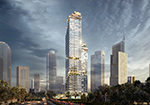
Two Sudirman Jakarta, Indonesia
Mitsubishi Estate is jointly advancing a large-scale, mixed-use development project in the center of Jakarta, Indonesia in partnership with PT Benhil Property and PT Taspen Properti Indonesia, the real estate subsidiary of PT Taspen, a state-run company that manages the pension fund for Indonesian public servants. The project comprises two super high-rise towers: a 74-story offices, a hotel/serviced apartment, and retail tower(Tower A), and a 65-story residential condominium tower(Tower B), On the environmental front, the office component is targeting Platinum certification from the Green Building Council Indonesia while efforts are also being made to enhance the property’s value through environmentally conscious design and development.
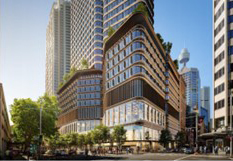
Parkline Place, Australia
Mitsubishi Estate has secured a green loan to finance the development and operation of Parkline Place, a premium office development in Sydney being developed and operated in partnership with Oxford Properties Group and its subsidiary Investa. Proceeds from the loan are being used to support a range of environmental initiatives, including environmentally conscious building design, the use of 100% renewable energy within the building, and initiatives toward net zero.
Through these initiatives, Parkline Place has achieved a 6 Star Green Star rating, the highest rating under Australia’s Green Star building sustainability rating system, as well as Platinum certification under the Core and Shell rating of the WELL Building Standard, an international certification focused on health and well-being. The project is also targeting a 5.5 Star Energy rating under the National Australian Built Environment Rating System (NABERS).
* See the following for more information on green loans.
ESG Report / ESG Data > Environment > Adopting Sustainable Finance
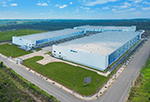
Logicross Nam Thuan, Vietnam
Mitsubishi Estate has been developing Logicross Nam Thuan, a large-scale logistics facility in Tay Ninh province on the outskirts of Ho Chi Minh City, and completed the project in June 2025. The facility consists of three single-story multi-tenant logistics buildings that can be divided into lots with a minimum floor area of approximately 3,000 m2. One of the buildings has berths (cargo handling platforms) on both sides of the building and is designed to meet the needs of businesses that require logistics operations such as cross-docking. The facility is also equipped with emergency generators to support business continuity for tenant companies during disasters and power outages. The project pursued high quality leveraging development by a Japanese developer, including the active use of Japanese products. In addition, it features an environmentally-friendly design that includes the installation of LED lighting and water saving equipment in all the buildings and optimization of energy efficiency. As a result, the facility has attained the BD+C (Building Design and Construction) Certified status in the LEED environmental rating system by the U.S. Green Building Council (USGBC).
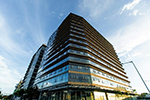
Savya Financial Center (North Tower), the Philippines
Savya Financial Center (North Tower) is a development of offices for sale being promoted in partnership with Arthaland, a real estate company in the Philippines, in the ARCA South area which is very close to Ninoy Aquino International Airport located in Metropolitan Manila in the Philippines. Using a design that increases day-to-day resource efficiency, the development will provide tenant companies with an operating performance which reduces power and water consumption by approximately 40% and greenhouse gas (GHG) emissions by 100%. The project has attained the WELL Health-Safety Rated status, and we also aim to obtain BERDE Stage 1 Certification, EDGE Final Certification, and LEED Gold Final Certification.
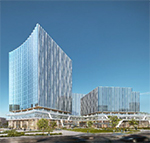
Crystal Bridge, China
This is a large-scale complex development project where construction began in 2023 in partnership with major U.S. developer Tishman Speyer, state-owned real estate developer New Changning Group, and Huolala, a major logistics services company. It is planned to earn LEED Gold certification for the project by greening just under 40% of the city block and considering the environmental performance of the buildings.
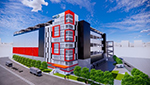
Halo Taoyuan Two, Taiwan
This logistics development project is a joint venture with ARCH Capital Management, a company based in Hong Kong that invests in real estate development in Asia. It is the first logistics facility development project in Taiwan by a Japanese developer. The project plans to install solar panels on the roof to self-supply approximately 60% of the electricity consumption and to obtain LEED Silver certification.
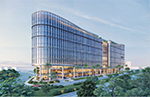
Kalina Project / India
A large-scale office development project being jointly developed with Hines and Sumitomo Corporation in Kalina, an emerging business district in Mumbai, India’s leading financial and commercial hub. The project will feature a high-grade office building with 12 floors above ground and 7 basement levels on a site of approximately 13,000 m2, with completion scheduled for around 2028.
Designed with environmental performance in mind, the building will feature a façade with Low-E coated glass offering excellent daylighting, sound insulation, and thermal performance, as well as efficient floor plates. The project is targeting LEED Platinum, WELL Gold, WiredScore Platinum, and SmartScore Gold certifications.
Extensive open spaces, dining facilities, and a fitness and wellness center will also be provided in the common areas, with the aim of creating a new landmark that combines comfort and convenience.

